MEDICOVI's own clinical studies
MEDICOVI water wave insoles and balance improvement in Parkinson's disease
A clinical study and balance measurement (Aalborg University, Prof. Pascal Madeleine and Prof. Uwe Kersting) showed that MEDICOVI insoles contribute to an immediate improvement in stability for patients with Parkinson's disease. Patients reported improved gait, the ability to stand on one leg, and less fatigue during movement. Electronic measurements showed rapid balance adjustment within milliseconds.
Balance training after stroke using MEDICOVI insoles
Controlled clinical study (Århus School of Physiotherapy, n=25, age 65+): after three weeks, the intervention group with MEDICOVI insoles recorded an average improvement of 2.2 points on the BBS scale compared to 0.09 points in the control group (p=0.046). Participants reported warmer feet, more walking, and reduced numbness.
Balance training in patients with multiple sclerosis using MEDICOVI insoles
Survey and measurement study (Sclerosis Society of Denmark, 2011, n=78): after 1 week of wear, 60% of participants reported immediate improvement in balance, which further strengthened after 6 weeks. 2 patients no longer needed foot drop orthoses. Patients reported warmer feet and relief from musculoskeletal pain.
Interview and balance assessment in 8 patients with multiple sclerosis using MEDICOVI T40
Pilot study (Aalborg University, n=8, F-Scan® pressure analysis): all patients reported improved balance, 5 increased physical activity, 2 no longer needed foot drop orthoses after 6 weeks. They reported warmer feet, less back pain, and greater confidence when walking.
MEDICOVI-REHA insoles for patients with diabetic peripheral neuropathy
A clinical study (Waagstein Madsen et al., 2021) showed immediate balance improvement in 80 % of patients, and complete symptom remission in over 70 % of those with painful neuropathy. Long-term use resulted in a return of sensation and improved foot flexibility.
Study on the effect of the water-filled membrane insole T40 on diabetics with neuropathy
An 8-month clinical study with MEDICOVI T40 in patients with diabetic peripheral neuropathy showed: immediate improvement in balance, alleviation of pain and discomfort in the legs, and resolution of cold feet sensation. A reduction in callus formation and improved toe mobility were also noted.
Sensory foot massage with MEDICOVI water-filled insoles
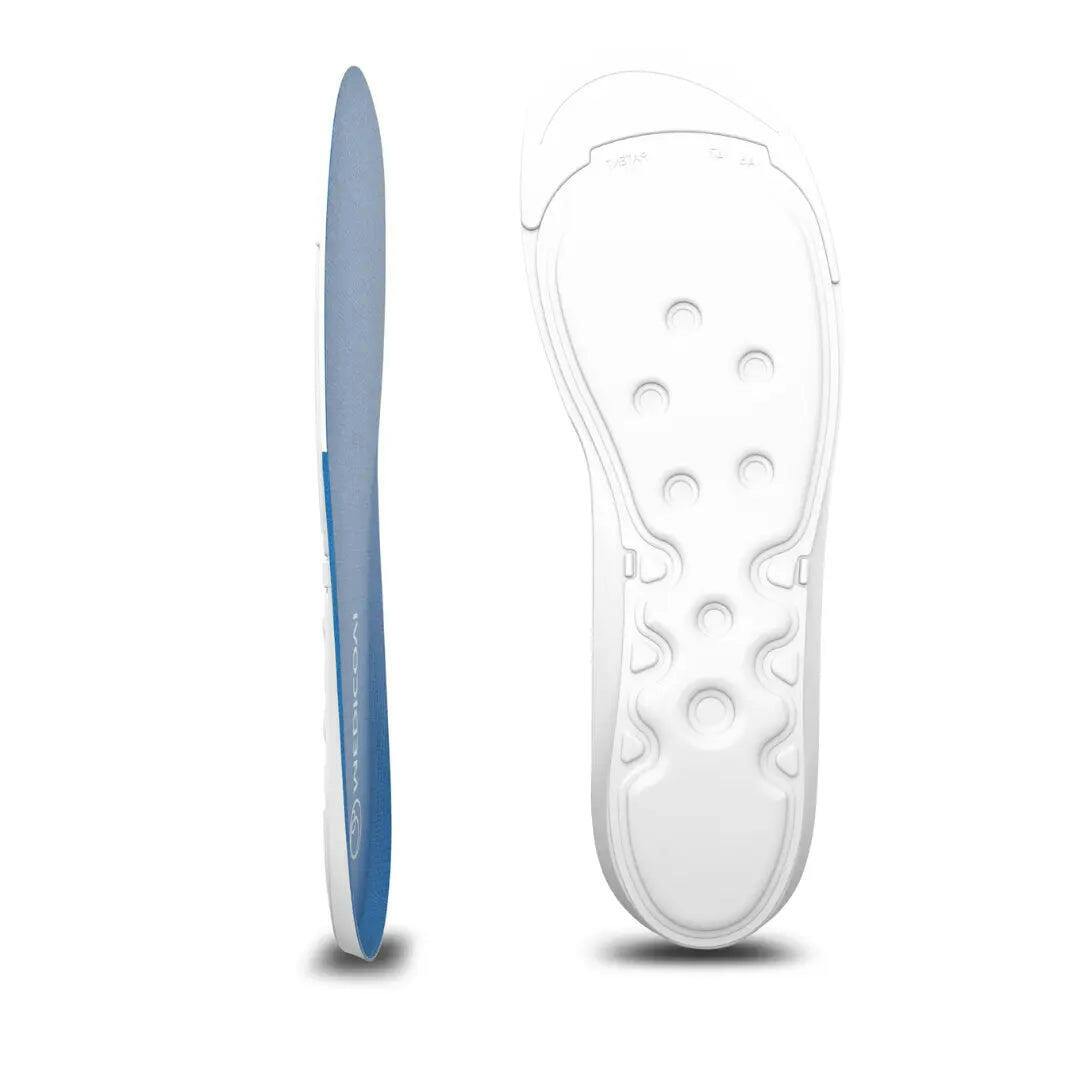
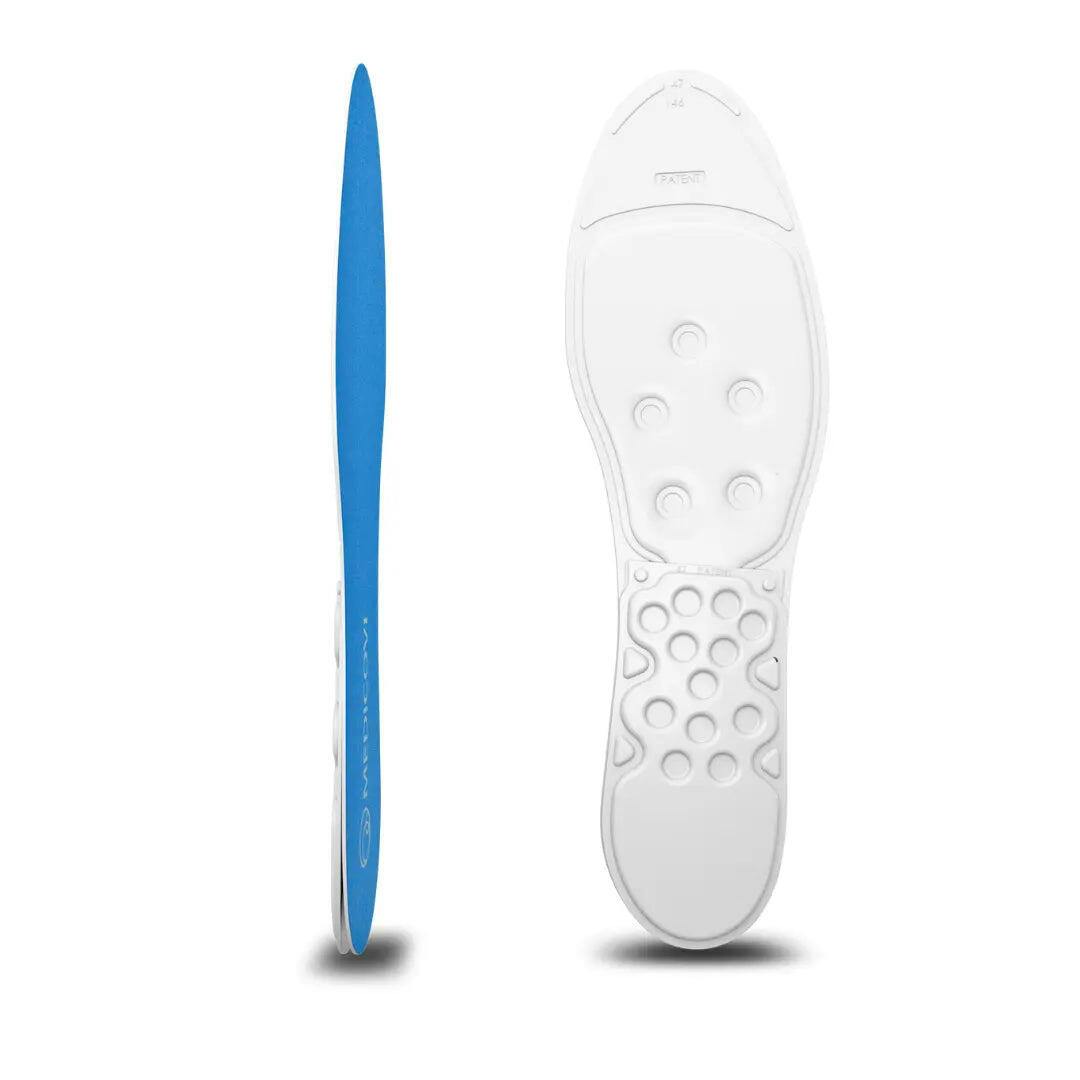
Study (University of Copenhagen + Aalborg University): MEDICOVI insoles create a 'sensory massage' for the foot — a dynamic interaction of pressures that can support blood circulation, stimulate muscle activity, and increase stability. More even pressure distribution on the heel and forefoot.
Variability of the centre of pressure — MEDICOVI H20 insoles test
Biomechanical study (Aalborg University): MEDICOVI H20 insoles reduce fluctuations in the centre of gravity when standing on one leg and when walking — more stable posture and more effective balance control.
Plantar fasciitis
Diagnosis and treatment of plantar fasciitis
A review in JAOA describes the diagnosis and conservative treatment of plantar fasciitis. Most patients have a good prognosis with a combination of conservative approaches, including orthopaedic insoles.
Hip Muscle Activity and Frontal Plane Lower Extremity Kinematics in Long-Distance Runners with Plantar Fasciitis
A study in the Journal of Applied Biomechanics: runners with plantar fasciitis have lower gluteal muscle activation and greater deviations in pelvic, hip, and knee movement — contributing to fascial overload.
Acute Effects of High-Intensity Interval Running on Plantar Fascia Thickness and Stiffness in Healthy Adults
A study in Journal of Applied Biomechanics: after 400 m sprints, a temporary decrease in fascial thickness and stiffness, regeneration after 30 min rest. Indicates the need for appropriate loading and recovery.
Does local steroid injection have a prognostic value for endoscopic plantar fascia release?
A clinical study in BMC Musculoskeletal Disorders (n=100): patients with a temporary response to steroid injection had better outcomes after endoscopic fascial release.
Can kinesio tape negatively affect plantar fasciitis treatment? A randomized clinical trial
RCT in PLOS ONE: kinesio taping combined with shockwave therapy did not provide additional pain relief and led to less functional improvement than shockwave therapy alone.
Standard reference values of weight and maximum pressure distribution in healthy adults aged 18–65 years
Study in Journal of Foot and Ankle Research (n=416): heel loading ~55%, forefoot ~45%. A basis for understanding pressure distribution during walking.
Foot biomechanics and orthotics
The foot core system: a new paradigm for understanding intrinsic foot muscle function
McKeon et al., Br J Sports Med 2015;49(5):290. The intrinsic foot muscles are activity-dependent — without dynamic loading, they atrophy. The basis for dynamic orthotics. doi:10.1136/bjsports-2013-092690
The effect of a 12-week custom foot orthotic intervention on intrinsic foot muscle size
Protopapas K, Perry SD. Clin Biomech 2020;78:105063. Rigid custom orthotics in young adults with flat feet (n=18): −17,4 % abductor hallucis after 12 weeks. Key evidence. PubMed 32521283
Foot orthoses for plantar heel pain: a systematic review and meta-analysis
Biomechanical study in Journal of Biomechanics: the greatest load on the plantar fascia occurs under the heel and the first toe — precisely where MEDICOVI distributes pressure with a water wave.
Effectiveness of foot orthoses to treat plantar fasciitis: a randomized trial
Study in Journal of the Royal Society Interface: intrinsic muscles actively control the foot arch under load — the basis of stability and energy saving.
Finite element analysis of plantar fascia under stretch
Biomechanical study, Journal of Biomechanics: the greatest load on the fascia occurs under the heel and the first toe — where MEDICOVI distributes pressure with a water wave. PubMed 18502428
Intrinsic foot muscles have the ability to control longitudinal arch deformation
Study, Journal of the Royal Society Interface: intrinsic muscles actively control the foot arch under load — the basis for stability and energy saving. doi:10.1098/rsif.2013.1188
The effectiveness of foot orthoses and shock-absorbing insoles in injury prevention
Bonanno DR et al., Br J Sports Med 2017;51(2):86. Orthoses and shock-absorbing insoles reduce the overall risk of injury; the most consistent effect is on stress fractures. doi:10.1136/bjsports-2016-096671
Tendons and mechanotransduction
The pathogenesis of tendinopathy: balancing the response to loading
Magnusson SP et al., Nat Rev Rheumatol 2010;6(5):262. Tendons require cyclic mechanical loading to maintain collagen homeostasis. Without loading, the activity of specific genes decreases within a few days. doi:10.1038/nrrheum.2010.43
Influence of simulated microgravity on human tendon mechanical properties
Reeves ND et al., J Appl Physiol 2005;98(6):2278. The Achilles tendon loses stiffness in the absence of loading — the basis for the argument for dynamic stimulation. doi:10.1152/japplphysiol.01266.2004
The impact of loading, unloading, ageing and injury on the human tendon
Maganaris CN et al., J Physiol 2019. Achilles tendon: −30 % stiffness after 20 days without load, −60 % with paralysis. Tendons are dynamic tissue. PMC6395417
Neuropathy and sensory stimulation
Somatosensory-stimulating foot orthoses improve postural balance in older adults
Gait & Posture 2025: sensory orthoses stimulating foot mechanoreceptors improve balance in older adults more effectively than traditional rigid insoles. sciencedirect.com
Foot sole vibration intensities and locations for static stability in older adults
Gait & Posture 2025: vibratory stimulation improves balance and reduces the risk of falls in healthy older adults. sciencedirect.com
Plantar mechanical stimulation attenuates unloading-induced skeletal muscle atrophy
Scientific Reports 2021: plantar mechanical stimulation increased neuromuscular activity and inhibited unloading-induced skeletal muscle atrophy. doi:10.1038/s41598-021-89362-6
Hallux valgus
Muscle imbalance in hallux valgus: an electromyographic study
Arinci İncel N et al., Am J Phys Med Rehabil 2003;82(5):345. EMG study: in hallux valgus, the abductor hallucis muscle is weakened, and the adductor hallucis muscle dominates. Causal relationship. PubMed 12704272
Ultrasonic evaluation of the abductor hallucis muscle in hallux valgus
Stewart S et al., BMC Musculoskelet Disord 2013;14:45. Ultrasound confirmed a significant reduction in abductor hallucis with grade 2 and 3 hallux valgus. doi:10.1186/1471-2474-14-45
Morton's Neuroma
Morton's Neuroma or Intermetatarsal Bursitis – A Prospective Diagnostic Study
A study in Diagnostics (n=26): 54% had bursitis, only 19% had Morton's neuroma on MRI. Ultrasound did not identify Morton's neuroma. This highlights the need for precise diagnosis.
Retrospective Study of Morton's Neuroma: Clinical and Therapeutic Assessment
A study in Cureus (n=10): corticosteroid injections were effective in 90% of patients. Surgical intervention was only necessary if conservative therapy failed.
Diabetic foot
Diabetic Foot Prevention – A neglected opportunity in high-risk patients
A study in Diabetes Care: high-risk diabetic patients rarely receive preventative services, including therapeutic insoles — despite the fact that this significantly reduces the incidence of ulcers and amputations.
Prediction of Diabetic Foot Ulcer Occurrence Using Commonly Available Clinical Information
A study in Diabetes Care: a simple predictive tool can accurately determine the risk of diabetic ulcers. High-risk patients had an astonishing 83-fold higher probability of ulceration.
Health-related quality of life of diabetic foot ulcer patients and their caregivers
A multicentre study in Diabetologia: chronic diabetic ulcers significantly reduce the quality of life for patients and their carers. Healing the ulcer brought a noticeable improvement in physical, social, and psychological functions.
Foot care for people with diabetes in the NHS in England: The economic case for change
NHS analysis: ulcers and amputations in diabetics cost the health service >£600 million annually. Many of these are preventable — rapid access to multidisciplinary teams significantly reduces the number of amputations.
Basic concepts to novel therapies: a review of the diabetic foot
Review in Annals of Medicine: causes, risk factors, and new therapeutic approaches in diabetic foot. Highlights the role of peripheral neuropathy and vascular diseases.
Ulcer-free survival after treatment of diabetic foot ulcers
Clinical study in Diabetic Medicine (n=370): only 36 % of patients remained ulcer-free long-term. Recurrences were common, especially in patients with neuropathy.
Prevalence, outcomes, and costs of diabetic foot ulcers
A retrospective study in Diabetes Care: Approximately 6% of diabetics develop an ulcer within 3 years. A higher incidence of osteomyelitis (15%), amputation (16%) and increased mortality were noted.
Mortality rates and diabetic foot ulcers: is it time to communicate mortality risk to patients?
A study in JAPMA: the five-year mortality rate after the onset of a diabetic ulcer is 43–55%, and after amputation, it is as high as 74% — higher than for several types of cancer.